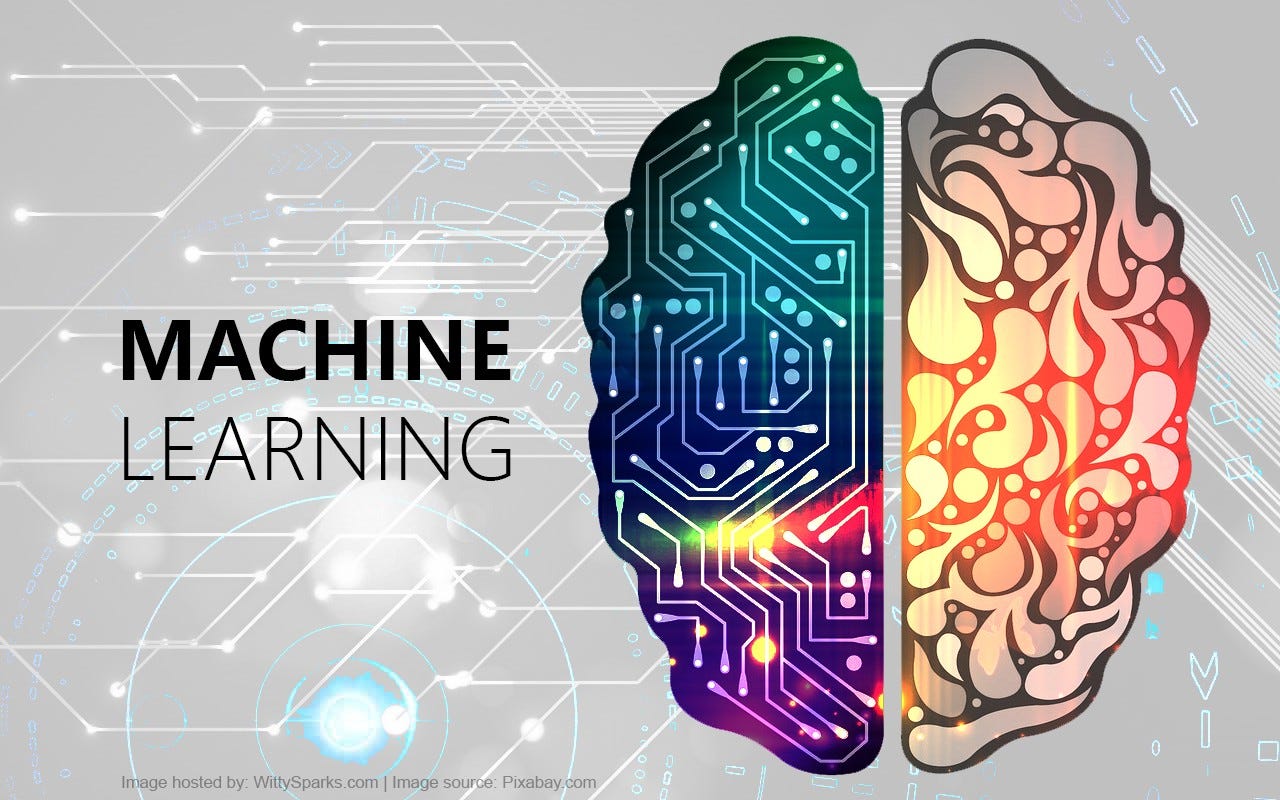
Machine learning is the subset of artificial intelligence (AI) focused on algorithms that can “learn” the patterns of training data and, subsequently, make accurate inferences about new data. This pattern recognition ability enables machine learning models to make decisions or predictions without explicit, hard-coded instructions.
Machine learning has come to dominate the field of AI: it provides the backbone of most modern AI systems, from forecasting models to autonomous vehicles to large language models (LLMs) and other generative AI tools.
The central premise of machine learning (ML) is that if you optimize a model’s performance on a dataset of tasks that adequately resemble the real-world problems it will be used for—through a process called model training—the model can make accurate predictions on the new data it sees in its ultimate use case.
Training itself is simply a means to an end: generalization, the translation of strong performance on training data to useful results in real-world scenarios, is the fundamental goal of machine learning. In essence, a trained model is applying patterns it learned from training data to infer the correct output for a real-world task: the deployment of an AI model is therefore called AI inference.
Machine learning has come to dominate the field of AI: it provides the backbone of most modern AI systems, from forecasting models to autonomous vehicles to large language models (LLMs) and other generative AI tools.
The central premise of machine learning (ML) is that if you optimize a model’s performance on a dataset of tasks that adequately resemble the real-world problems it will be used for—through a process called model training—the model can make accurate predictions on the new data it sees in its ultimate use case.
Training itself is simply a means to an end: generalization, the translation of strong performance on training data to useful results in real-world scenarios, is the fundamental goal of machine learning. In essence, a trained model is applying patterns it learned from training data to infer the correct output for a real-world task: the deployment of an AI model is therefore called AI inference.
What You'll Learn
Build and train supervised learning models including linear regression, logistic regression, decision trees, and support vector machines for classification and regression tasks.
Implement unsupervised learning algorithms such as K-means clustering, hierarchical clustering, and principal component analysis (PCA) for pattern discovery.
Evaluate model performance using cross-validation, confusion matrices, ROC curves, and appropriate metrics like accuracy, precision, recall, and F1-score.
Apply feature engineering, regularization techniques (Lasso, Ridge), and hyperparameter tuning to optimize machine learning model performance.
Prerequisites
Intermediate Python Programming: Strong understanding of classes, libraries (NumPy, Pandas, Matplotlib), and data manipulation. Core Statistics & Probability: Understanding of mean/median, standard deviation, distributions, hypothesis testing, and probability rules. Linear Algebra Basics: Knowledge of vectors, matrices, matrix multiplication, and dot products. Calculus Basics: Understanding of derivatives and gradients (conceptual level is often sufficient for beginners).
Course Content
0 lessonsIntroduction to Machine Learning
Session 1:What is Machine Learning? Types (Supervised vs Unsupervised)
Real-world applications
Session 2:
ML workflow (data → training → evaluation)
Introduction to datasets
Session 3:
Python tools for ML (NumPy, Pandas, Matplotlib)
Data Preprocessing & Feature Engineering
Session 1:Data cleaning (missing values, duplicates)
Session 2:
Feature scaling (normalization, standardization)
Session 3:
Feature engineering basics
Linear Regression
Session 1:Simple linear regression (concept & math intuition)
Session 2:
Multiple linear regression
Session 3:
Model evaluation (MSE, RMSE, R²)
Classification Models
Session 1:Logistic regression (binary classification)
Session 2:
Decision trees
Session 3:
Support Vector Machines (SVM)
Model Evaluation Techniques
Session 1:Train/test split & cross-validation
Session 2:
Confusion matrix, accuracy, precision, recall
Session 3:
ROC curve & F1-score
Unsupervised Learning
Session 1:K-means clustering
Session 2:
Hierarchical clustering
Session 3:
Principal Component Analysis (PCA)
Regularization & Model Optimization
Session 1:Overfitting vs underfitting
Session 2:
Regularization (Lasso, Ridge)
Session 3:
Hyperparameter tuning (Grid Search, Random Search)
Final Project & Deployment Basics
Session 1:End-to-end ML project workflow
Session 2:
Model selection and improvement
Session 3:
Introduction to deployment (basic concepts)

Tochukwu Udeh
Lead Instructor
About the Instructor
Improving lives, unlocking potentials and fulfilling destinies

No Reviews Yet
Be the first to review this course!

